



When companies consult us about hiring foreign nationals, there is one question we hear at almost every initial meeting.
"Which visa should we apply for?"
It is, of course, a perfectly valid question. What we find in practice, however, is that companies whose recruitment goes smoothly tend to invest considerable time in the groundwork before that question even arises.
What is the reason for the hire? What role will the person fill? What knowledge and experience does that role require? In our experience, companies that have worked through these questions find that the subsequent procedures follow far more naturally.
It is for this reason that we say hiring foreign nationals does not begin with the visa application — it begins the moment you start thinking about your hiring plan.
Define the Role Before Thinking About the Visa
The word "visa" is widely used in everyday conversation, but foreign nationals who wish to reside in Japan for the medium to long term are granted a status of residence corresponding to the nature of their activities (see: Immigration Services Agency of Japan).
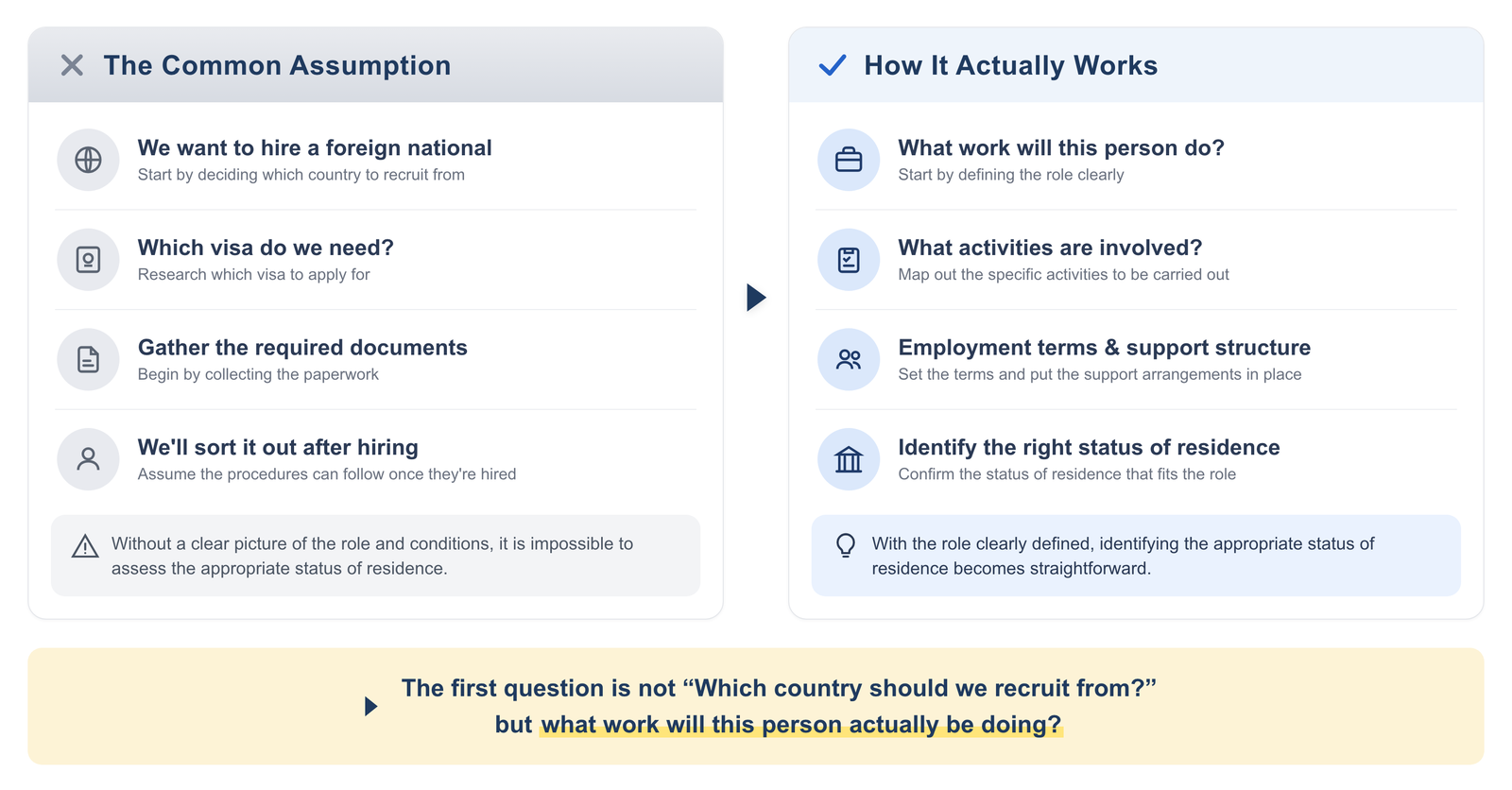
Japan's status-of-residence framework is organised not around "which country the person comes from", but around what activities they will carry out in Japan. Because the status of residence is defined by those activities, it is impossible to assess the appropriate status until the role itself has been clearly defined.
The first question to ask, therefore, is not "Which country should we recruit from?" but "What work will this person be doing?" Only once the role is clearly defined can the question "Which status of residence might be appropriate?" begin to be answered.
There Is No Single "Work Visa" Category
The term "work visa" (就労ビザ) is common in everyday speech, but no status of residence by that name actually exists.
For example:
- Engineer/Specialist in Humanities/International Services (技術・人文知識・国際業務)
- Specified Skilled Worker (特定技能)
- Highly Skilled Professional (高度専門職)
Each covers different permitted activities and serves different policy objectives (see: Immigration Services Agency of Japan).
The process, in other words, is not "We are hiring a foreign national, so it must be Specified Skilled Worker" — it is to assess which status of residence is appropriate in light of the specific role and employment conditions.
Application Documents Are Your Hiring Plan Made Formal
People often assume that applying for a status of residence is primarily a matter of gathering the required documents. In practice, however, those documents reflect:
- the nature of the work to be performed
- the terms and conditions of employment
- the arrangements the company has in place to host the individual
These are precisely the kinds of details reflected in the application documents. In other words, those documents are, in effect, your hiring plan made formal.
A well-structured hiring plan produces consistent, coherent documentation. Conversely, where the role or employment conditions remain unclear, the subsequent process may require considerably more time.
Responsibilities Continue After Permission Is Granted
Obtaining approval for a status of residence is not the end of the process.
After hiring, in addition to standard employment procedures such as social insurance enrolment, the Notification of Employment of Foreign Nationals is required. Depending on the status of residence, accepting (host) organisations may also be required to provide ongoing support and submit periodic reports.
It is therefore important to consider not only "Can we obtain approval?" but also "Can we create an environment in which this person can work with confidence long-term?" — and to build that thinking into the hiring plan from the outset.
In Closing
When people hear the phrase "hiring foreign nationals", status of residence and application procedures are often the first things that come to mind — and of course, those are indispensable steps.
What we find through our day-to-day consultations, however, is that the companies whose recruitment goes well are invariably those that have taken care with the groundwork that comes before.
Define the role clearly. Think through the arrangements to host your new colleague. Then identify the status of residence that fits. It is this careful preparation that leads, in turn, to a smoother application and a more stable experience once the person is on board.
In future posts, building on this foundation, we will explain topics such as what Specified Skilled Worker (特定技能) actually involves, and what kind of status of residence Engineer/Specialist in Humanities/International Services (技術・人文知識・国際業務) is — all from a practical standpoint.
🧭 For Companies Beginning to Consider Hiring Foreign Nationals
Our International Recruitment Services support you from structuring your hiring plan and assessing the appropriate status of residence through to post-arrival support — all from a practical standpoint. We welcome enquiries even at the stage where you are not yet sure where to begin.