Hello, everyone.
I'm one of the study-abroad support staff here.
For anyone Japanese,
"toshikoshi" —
seeing out the old year and welcoming in the new —
is something a little special.
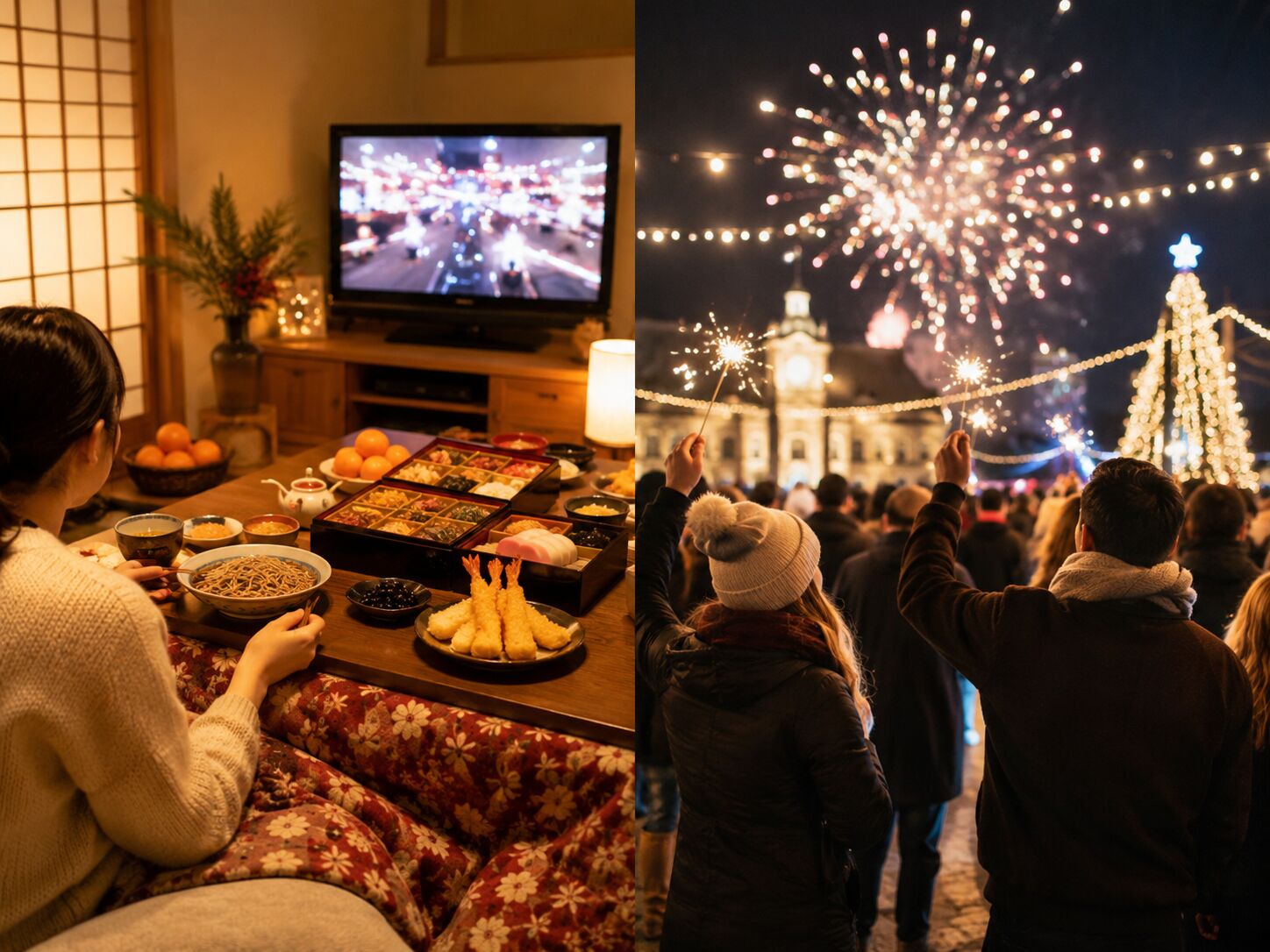
On ōmisoka, New Year's Eve, family and relatives gather.
You eat a slightly grander meal than usual.
On television, the year-end specials run back to back.
Toshikoshi soba, noodles eaten on New Year's Eve, just before midnight.
Joya no kane, temple bells rung out as midnight approaches.
And then,
"Akemashite omedetou gozaimasu" —
Happy New Year —
and a new year begins.
For me too,
there has always been a feeling that
"the New Year, at least, is a time to stay home and take it easy".
And yet I have, in fact,
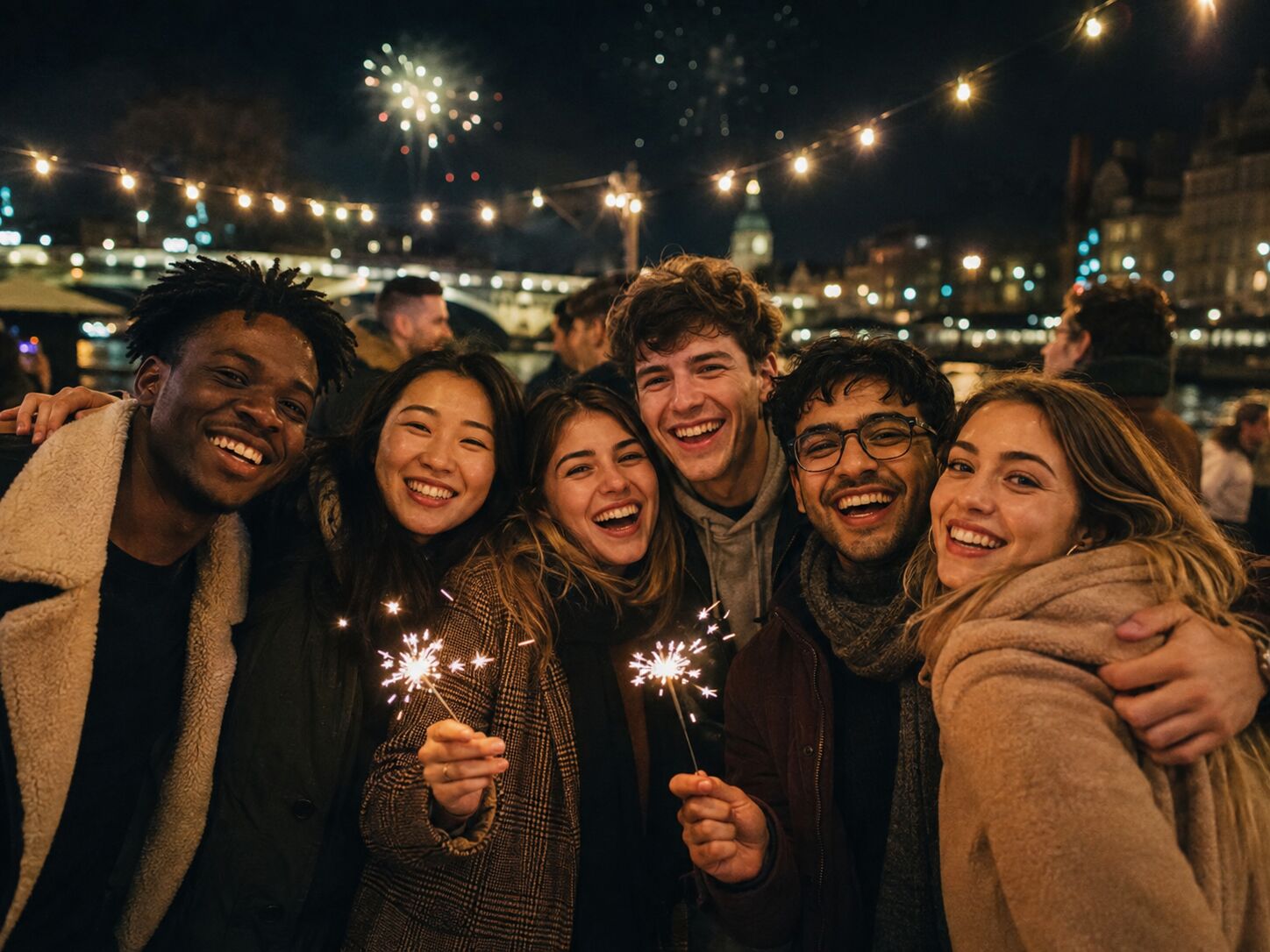
seen in the New Year in three different countries:
Australia.
Canada.
Singapore.
And every single time,
I remember thinking
"...wait, is that it?"
— a little anticlimactic, if I'm honest.
Of course, it depends entirely on the country, and on where you spend it.
Some cities, like Sydney, mark it with fireworks famous the world over.
Others don't share Japan's culture of treating the first three days of January, shōgatsu sanganichi, as special family time at all.
But that's exactly what makes it interesting.
There may be surprisingly few days that let you feel a country's culture as directly as New Year's does.
So,
rather than a holiday abroad,
what about
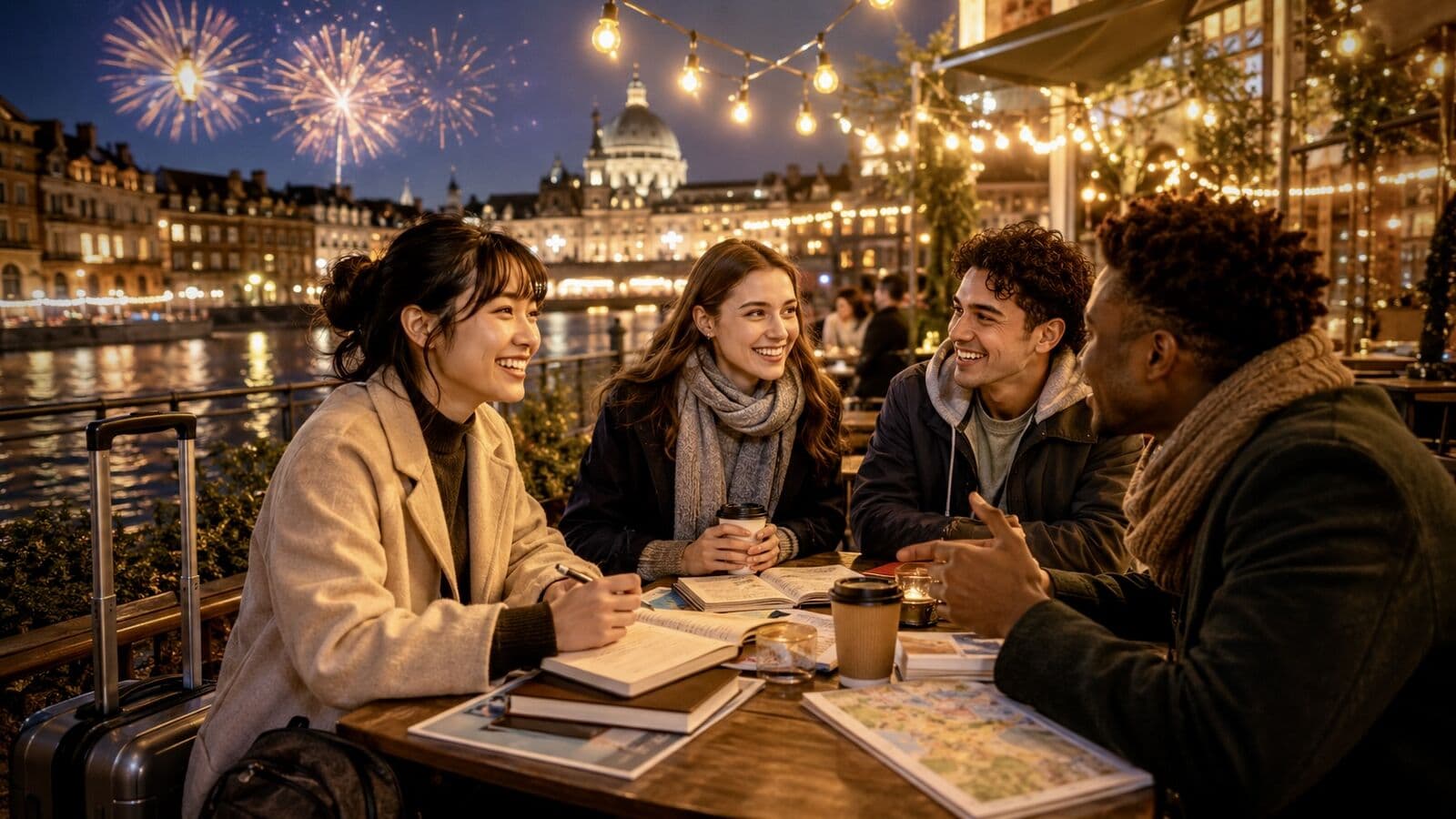
"studying abroad, and seeing in the New Year there"?
This time, I want to think through winter study abroad from December 2026 to January 2027 fairly realistically:
lessons.
cost.
flights.
New Year where you're staying.
and a preparation schedule starting in September.
First, in a single sentence
Having looked into all this, there's something I came away feeling.
There's no need to assume that "the year-end and New Year period is a bad time to study abroad".
That said,
it may not suit someone who wants exactly the same number of lessons as at any other time of year.
This matters.
Christmas.
New Year's Eve.
New Year's Day.
These are public holidays in many countries too, and language schools may close over them.
In other words,
if maximising lesson hours is your only goal, another time of year is more efficient.
But,
if you want to learn English,
and experience New Year somewhere else,
and see in the New Year with friends from school,
and the winter holidays are the only stretch of time you can take,
then this is a kind of study abroad you simply can't have at any other time of year.
And this year, there's a little extra reason in its favour.
① The fuel surcharge has come down since September
When you're looking into travelling abroad,
and pull up a flight search,
one reason things look
"more expensive than I expected"
is the fuel surcharge.
A fuel surcharge is an extra charge collected on top of the standard airfare to cover swings in fuel prices. ANA, for one, reviews it regularly, based partly on the Singapore kerosene price.
And in September 2026,
both JAL and ANA brought their figures down.
For JAL, for example:
| Route group | Tickets issued Jul–Aug | Tickets issued Sep–Oct | Round trip |
|---|---|---|---|
| Philippines, Vietnam, Guam, etc. | ¥22,500 (approx. US$140) one-way | ¥17,500 (approx. US$110) one-way | ¥10,000 (approx. US$60) less |
| Oceania, North America, Europe, Middle East | ¥65,000 (approx. US$405) one-way | ¥50,000 (approx. US$310) one-way | ¥30,000 (approx. US$190) less |
※ The "Tickets issued Sep–Oct" figures apply to tickets issued between 1 September and 31 October 2026.
※ These are shared price bands covering several regions grouped together. Flights to Oceania are set at the same rate as flights to North America and Europe.
For ANA too,
the Philippines has gone from ¥22,500 to ¥19,300 (approx. US$140 to US$120),
and Oceania from ¥65,000 to ¥55,000 (approx. US$405 to US$345).
On a return ticket, that works out to a saving of ¥6,400 (approx. US$40) and ¥20,000 (approx. US$125) in fuel surcharge respectively.
For Australia in particular, we're talking tens of thousands of yen.
That's quite a lot, isn't it.
② But that doesn't mean "winter flights just got ¥30,000 cheaper"
A word of caution here.
The ¥30,000 figure above isn't a difference in the ticket price itself —
it's the difference in the fuel surcharge portion only.
Because demand for overseas travel rises in late December,
the base airfare itself may go up.
And flying out from New Chitose Airport — the main airport for Sapporo and Hokkaido, where this agency is based —
the total also depends on
domestic connections.
routing.
the airline.
and the booking class.
In other words,
"the surcharge came down in September" doesn't mean
"year-end flights are guaranteed to be at their cheapest".
But looked at the other way,
if you already have a trip abroad planned for the New Year period,
that's one more reason to start comparing flights now.
What's more, JAL's prices for tickets issued in September and October are, in principle, set to stay unchanged for that period, with the figures for tickets issued from November onwards due to be announced again in October.
Which is exactly why
"I'll start looking once December comes round"
isn't the plan.
Keep an eye on prices from September instead.
That's what matters.
③ Does a New Year study-abroad trip actually include lessons?
This is probably what you're most curious about.
The short answer is:
it varies a good deal from school to school.
④ At ILSC Sydney | The school properly closes over the New Year period
Take ILSC in Sydney first.
Looking at the official start-date calendar,
25 to 31 December 2026 is a closure period.
And 1 January 2027 is also closed.
So,
if you picture
"studying for two weeks from 21 December, attending lessons every day, and just watching the fireworks on New Year's Eve",
the reality may look quite different from what you imagined.
I want to be upfront about that.
On the other hand,
the new session for 2027
starts on Monday 4 January.
So personally, I'd suggest a combination like:
New Year in Sydney, then study from 4 January.
For example:
Arrive in Sydney around 28–30 December.
↓
Get your bearings in the city.
↓
See in the New Year at Sydney Harbour on 31 December.
↓
Sightsee from 1 to 3 January.
↓
Start lessons on 4 January.
This way, you get to enjoy
"seeing in the New Year in Sydney"
and
"properly studying English"
as two separate things.
⑤ And New Year in Sydney is... on another level entirely
Having just told you that
"New Year abroad is a surprisingly low-key affair",
Sydney might be the exception (so much for that theory).
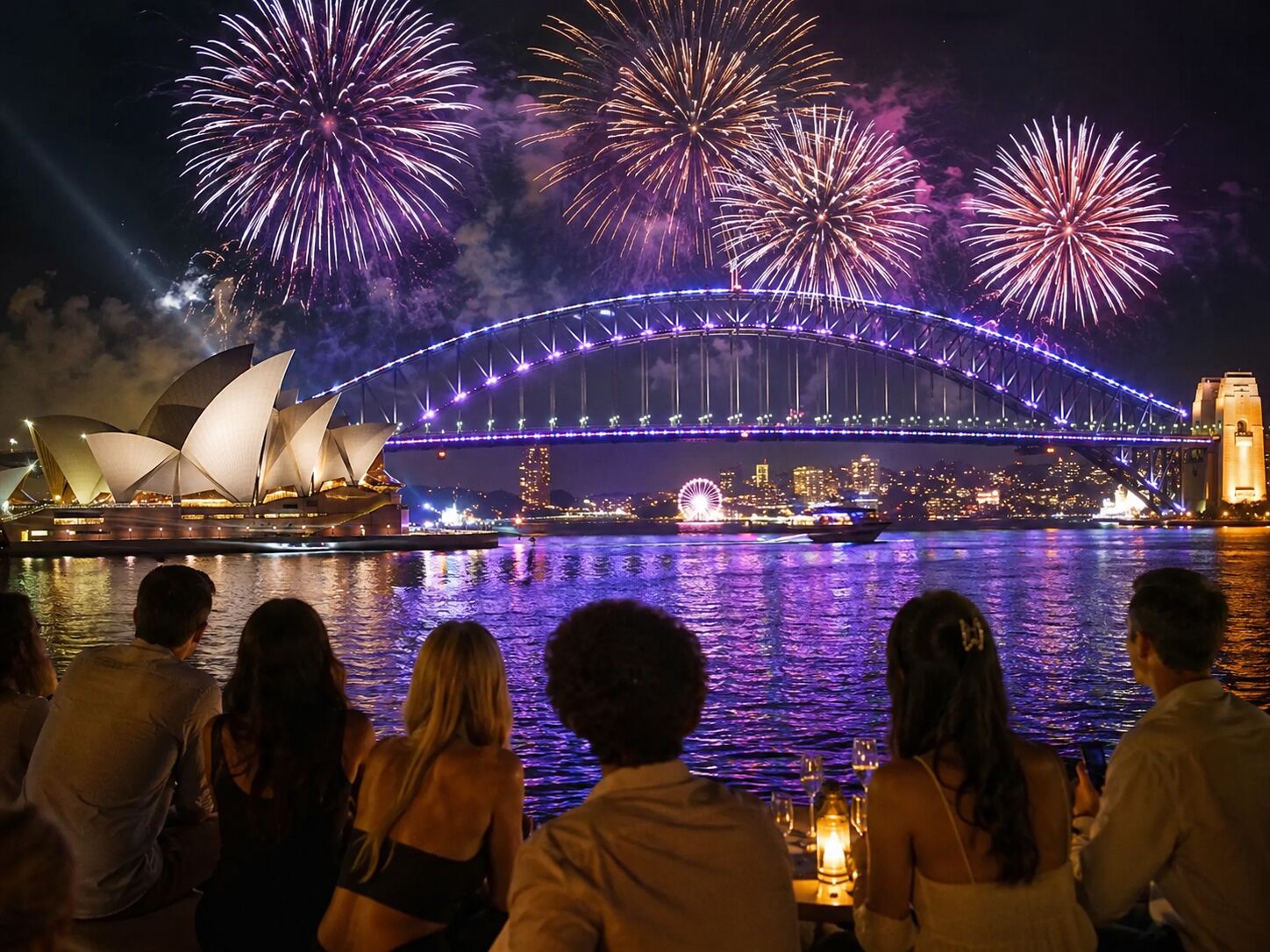
Sydney New Year's Eve is famous the world over.
For 31 December 2026,
a 9pm fireworks display
and
a midnight main display
are both planned.
According to the official website, tickets and ballots for the main viewing areas open progressively from early September, venue by venue.
The ballot for Cahill Expressway, and for Bradleys Head and Shark Island, opens on 3 September.
Taronga Zoo opens on 10 September.
The viewing area in front of the Opera House is the one exception, opening only from 26 December.
Which is,
again,
one more reason to start preparing in September.
Even if, on the night itself, you think
"let's head over near the Harbour Bridge, seeing as we're here!",
there's
entry restrictions.
road closures.
designated viewing areas.
and traffic restrictions to contend with.
The official website itself asks people to plan ahead, since more than a million people gather in the city centre and elsewhere on the night.
The details of road closures and transport arrangements on the day are due to be published on the official website around November.
If there's ever a year to see in the New Year watching world-famous fireworks,
at least once in your life,
then Sydney's New Year, 2026 into 2027, is a genuinely appealing choice.
⑥ In Cebu, you get to step into a Filipino New Year
In the Philippines, New Year's Eve has its own tradition:
Media Noche,
a New Year's Eve meal shared together as a family.
There's also a custom of
setting out around twelve kinds of round fruit
on the table, to wish for good luck in the year ahead — the round shape is thought to bring coins and prosperity to mind.
And the Filipino New Year is,
if anything, perhaps the opposite
of the "surprisingly quiet" New Years I'd experienced abroad up to that point.
It's genuinely lively.
Fireworks.
Music.
Horns.
The banging of pots and pans.
There's a custom of driving away bad luck with loud noise to welcome the New Year, and the government asks people every year to make that noise safely, to avoid firework accidents.
In other words,
it's nothing like a Japanese New Year.
And that's exactly what makes seeing in the New Year abroad so interesting.

⑦ Fewer lessons doesn't mean a worse deal — some schools run year-end promotions
At language schools in the Philippines,
because public holidays cluster together over the New Year period,
some schools set up:
- make-up classes
- special group classes
- year-end and New Year discounts
Some schools in Cebu are, for 2026–2027, offering discounts of around US$100–200 for the Christmas/New Year period, and others are scheduling make-up classes on Saturdays.
That said,
promotions vary by school, by when you book, and by how long you stay.
So rather than assuming
"there are public holidays, so it must be cheap",
I'd suggest comparing lesson numbers, discounts and the overall stay together.
⑧ Summing up the benefits of a New Year study-abroad trip
Let's pull this together so far.
〈Benefit ① An ordinary winter holiday becomes one you remember for good〉
2027, seen in abroad.
I think that's the kind of thing that stays with you.
"That was the year I watched the fireworks in Sydney."
"That was the year I had Media Noche with Filipino friends in Cebu."
Memories like that.
〈Benefit ② It's the clearest way to experience a culture different from Japan's〉
New Year is culture itself.
What you eat.
Who you spend it with.
What sounds fill the air.
How many days off you get.
Set against Japan, you may find yourself thinking
"oh — Japan's New Year is actually quite distinctive, isn't it."
〈Benefit ③ Some schools run promotions〉
Because it's a period with so many public holidays,
some schools set up perks like
discounts.
make-up classes.
special lessons.
and other extras besides.
〈Benefit ④ There's still preparation time, if you start in September〉
Right now, this isn't
"we leave next month!" territory.
Compare flights.
Compare schools.
Check your passport.
Check your work or school schedule.
Talk it over with your family.
You've got around four months to get ready.
⑨ My own "lost passport at New Year" story, from Canada
I have a New Year memory
that still makes me wince a little, even now.
While I was seeing in the New Year in Canada,
I lost my passport.
I thought,
"I can probably sort this out at the embassy or consulate",
but it was the New Year period.
Government offices were closed too.
It wasn't a situation where I could just walk in and get normal service straight away.
Over the New Year period abroad,
it isn't only restaurants and cafés that keep different hours —
embassies and consulates do too.
Even in NSW, where Sydney is,
25 December 2026 is Christmas Day,
26 December is Boxing Day,
28 December is Additional Day, the substitute holiday that follows it,
and 1 January 2027 is New Year's Day.
In the Philippines too, 24, 25, 30 and 31 December 2026 fall as public holidays or special non-working days.
And diplomatic missions close for even longer than that.
The Consulate-General of Japan in Sydney is closed from 25 to 31 December 2026.
The Embassy of Japan in the Philippines is closed on 24, 25, 30 and 31 December.
So,
if you're studying abroad over the New Year,
please really do look after your passport (you can guess why).
And I'd recommend saving the following to your phone too:
your travel insurance details.
your school's emergency contact.
the Japanese embassy or consulate.
your card issuer's lost-card line.
⑩ So what do you do from September? A reassuring, worked-backwards schedule
Now for the practical part.
If you're leaving at the end of December 2026,
to see in 2027 abroad,
here's the kind of schedule I'd suggest.
◇ September | The month you decide whether to go at all
First,
work out whether Sydney or Cebu suits you better.
Then check:
- how long you're free to be away
- the school's closure dates over the New Year period
- room availability
- roughly what flights are costing
- your budget
You don't need to actually buy a ticket at this point.
But do check,
at least once,
what it would cost if you bought today.
JAL and ANA's fuel surcharge cuts apply to tickets issued in September and October.
If you're seeing in the New Year in Sydney, this is also when to start checking NYE viewing information.
◇ October | Settle on a school, and get serious about flights
By October,
you'll want to have settled:
the school.
the course.
the room type.
the length of your stay.
JAL is also due to announce, in October, the fuel surcharge for tickets issued from November onwards.
In other words,
this is when you decide whether to book at the September–October price, or wait for the next announcement.
That said,
year-end flight prices move with seat availability as well as the surcharge,
so waiting too long in hope of a further drop isn't something I'd recommend either.
◇ November | Get your travel arrangements in order
Around now, check:
- travel insurance
- entry requirements
- how much validity is left on your passport
- SIM or eSIM
- your card
- local currency
- airport transfers
- what to pack
And this is roughly when to start deciding
"how will we spend 31 December?"
Sydney especially has viewing areas that need booking, or entry management, in advance.
◇ Early December | Brush up your English, and a final check
There's no need to study difficult English.
Just practise the English you'll actually use for:
introducing yourself.
the airport.
the hotel.
shopping.
school.
Then check once more:
the school's latest year-end schedule.
your flights.
airport transfers.
any New Year events.
emergency contacts for government offices.
◇ Late December | Off you go
And then,
take a break from a Japanese New Year, just this once, and head abroad.
There may be no toshikoshi soba.
No kotatsu, the blanket-covered low table with a heater underneath.
No osechi, the traditional New Year food.
But instead,
new friends you've met abroad.
an unfamiliar city.
time spent immersed in a new culture.
Surely a year like that, just once,
isn't such a bad thing.
Closing | How about saying "Happy New Year" abroad in 2027?
Every time I've seen in a New Year abroad,
my first thought, without fail, has been
"I'd rather be having New Year in Japan" — I admit it.
No osechi.
No ozōni, the New Year mochi soup.
No Kōhaku, the big NHK New Year's Eve song contest, to watch.
No relatives around.
And far fewer people to say
"Akemashite omedetou gozaimasu" to than I'd have in Japan.
But,
however many years go by,
it's oddly often the New Years I spent abroad that I still remember.
"That was the year I was in Canada."
"That was the year I was in Australia."
The year itself and the place are lodged together in memory.
And even losing my passport in Canada at New Year
has, by now, turned into a blog post (small mercies).
Things don't always go to plan abroad.
But even that becomes part of what makes it memorable.
2027.
If you'd like to start it a little differently than usual,
seeing in a new year in a new country, with a new language, among new people —
that kind of study abroad, too,
I think would make an experience you won't forget.