



Hello, everyone. I'm one of the study-abroad support team at JAPAN POLARIS.
This may come rather out of the blue, but have you ever found yourself wondering:
"Has Japanese people's English actually got any better over the past twenty years?"
It's a question I've turned over in my own mind for a long time.
I'm around forty now, and I first started learning English properly at school when I was thirteen. I liked English from my very first encounter with it, and before long I was thinking, "One day I'd like to talk to someone from another country," and "I want to know more about the world beyond Japan." That's where my strong interest in international affairs began, too.
I certainly didn't dislike English at school, either. I memorised the vocabulary, worked through the grammar, and I think I revised conscientiously for the tests.
Then, as an upper-secondary student, I went to Australia to study — and all that confidence was comprehensively shattered.
My English simply didn't get through.
Teachers and friends spoke fast. Even when I caught what they said, I couldn't produce a reply on the spot. While I was still assembling the grammar in my head, the conversation had already moved on without me.
There was also the chance, while I was there, to mix with students of my own age who had come from around thirty different countries. People differ, of course, and this is only how it looked to me at the time. Even so, we Japanese students seemed to be having real trouble putting our own thoughts across in English.
"After all that diligent study…"
Honestly, it was quite a shock.
That was about twenty years ago. School education has changed since then. The internet and smartphones are everywhere, and connecting with people abroad has become far easier.
So has Japanese people's English itself genuinely improved?
Looking back on my own experience of twenty years ago, I'd like to think it through alongside the data, from four angles: the English we acquire at school, the English we actually use, our sense of being bad at English, and studying abroad.
First, the short answer
Let me give you the conclusion up front: over these twenty years, the English that Japanese people acquire at school has unmistakably improved.
But between knowing English and being able to use it, a considerable wall still stands.
And there is one more thing that has changed a great deal.
Studying abroad — the option that takes you over that wall — is far more within reach than it was twenty years ago.
Let's take it one step at a time.
1. Twenty years ago, how much English could Japan's secondary-school students manage?
Let's start with figures from Japan's Ministry of Education, Culture, Sports, Science and Technology (MEXT) for the 2007 school year — close to the time I was at upper-secondary school myself.
Back then, 32.4% of students in their final year of lower secondary school (around the age of fifteen) had English equivalent to Grade 3 or above in Eiken, Japan's standard English proficiency test. Among final-year upper-secondary students (around the age of eighteen), 30.3% had English equivalent to Eiken Grade Pre-2 or above — Pre-2 being the level immediately above Grade 3, since Eiken's numbering runs downwards as the levels rise.
In other words, roughly one in three in each group. MEXT itself judged that this fell short of the targets it had set at the time.
Looking back now, that picture chimes, in a way, with my own experience abroad.
At school you study the grammar and the vocabulary. In a test you can answer well enough.
And then the moment you step outside Japan, someone asks
"What do you think?"
and the words stop dead.
I had the knowledge, all right. What I think I had very little of was experience of using it in real communication.

2. And today? The English learned at school has come a long way
So where do things stand now?
In MEXT's survey for the 2025 school year (Reiwa 7), 54.6% of final-year lower-secondary students were assessed as reaching CEFR A1 or above — the first level of the Common European Framework — which is taken to correspond broadly to Eiken Grade 3 or above. Among final-year upper-secondary students, 52.4% were assessed as reaching CEFR A2 or above, broadly Eiken Grade Pre-2 or above.
Where twenty years ago it was around one in three, today the figure is more than one in two.
The two surveys are not the same, and English ability is not judged in the same way in each, so they cannot simply be set side by side. Even so, we can at least say that attainment in English at school has steadily improved.
Something else has changed even more strikingly: the age at which children begin learning English.
In my generation, it was not unusual for people to have first studied English properly on reaching lower secondary school.
From the 2011 school year, foreign language activities became compulsory in years 5 and 6 of primary school. Under the current Course of Study (the national curriculum guidelines), those activities have been brought forward to the middle years of primary school (years 3 and 4), while in years 5 and 6 "foreign language" has become a graded subject in its own right. The point at which children first encounter English has itself moved earlier.
That is a very considerable difference from twenty years ago.

3. So does that mean Japanese people can speak English now?
This is the part I most wanted to think about.
English ability at school is rising. But has the ability to stand in front of someone from another country and convey your own thinking in English risen in the same way?
One useful reference here is the EF English Proficiency Index (EF EPI), which covers adults around the world.
In the 2025 edition, Japan scored 446, placing 96th out of the 123 countries and regions covered. Broken down by skill, it looks like this:
| Skill | Score |
|---|---|
| Reading | 454 |
| Listening | 437 |
| Writing | 394 |
| Speaking | 393 |
This survey is of course based on data from people who chose of their own accord to sit EF's English test, and it does not straightforwardly represent "the English ability of all Japanese people".
What is interesting all the same is that the output side — speaking and writing — scores lower than reading.
That feeling I had in Australia twenty years ago —
"the moment I try to speak, the words won't come"
— may, in a different form, still be unfinished business for Japanese people today.

4. Has Japanese people's "English complex" gone away?
The other thing I find myself wondering about is that sense of simply not being good at English.
English teaching starts earlier, and the indicators of ability are improving. And yet you still hear, all the time:
"I get nervous when someone speaks to me in English." "I'd be embarrassed to make a mistake." "What if I can't catch what they say?"
In fact, in a 2024 survey of 501 men and women in their twenties to fifties by the Institute for International Business Communication (IIBC), the body that administers TOEIC in Japan, 70.2% answered that they were not good at English.
The most common reason given was "I have no opportunity to speak English, so I have no confidence," at 58.5%. Next came "I'm not confident I can catch spoken English," at 45.5%, and "I'm not confident in my vocabulary," at 37.5%.
There is something quite important buried in there, I think.
The reason Japanese people feel they are bad at English is not necessarily just that they haven't studied.
Isn't it much more that, having had so little experience of actually using English, they can't feel any confidence?
In the same survey, 77.6% said they would like to extend a warm welcome to overseas tourists visiting Japan.
So it isn't that people don't want to engage with visitors from abroad.
They would genuinely like to talk to them. They'd like to be of help. But they lack the confidence.
That is the picture that emerges.
I was exactly like that myself at upper-secondary school.
I liked English. I wanted to talk to people from other countries.
But while I was busy thinking
"It'll be embarrassing if I get it wrong" "Will my pronunciation even be understood?"
the chance to say anything had already gone.
5. Perhaps what's missing isn't study time, but time spent using English
Line up the data so far and something very interesting emerges.
The English acquired at school is better than it was twenty years ago. Children start learning English earlier.
And still, a great many people feel they are bad at English — and the reason they give is having no opportunity to speak it.
Which is why, when we think about learning English, we believe there is real value in asking not only
"how many more words can I memorise?"
but also
"how many times have I got the English I've learned out of my own mouth?"
Take being asked, "What did you do yesterday?" At first the answer might be no more than
"I went shopping."
Then, conversation after conversation, it grows a little longer:
"I went shopping with my friend, and we found a really nice café."
That kind of experience is hard to come by through desk study alone.
You get the English wrong. The other person asks you to say it again. You have another go. And then it lands.
Those small moments of "they understood me!" build up into confidence.
And one of the environments where you can pack a great number of them into a short space of time is, I think, studying abroad.
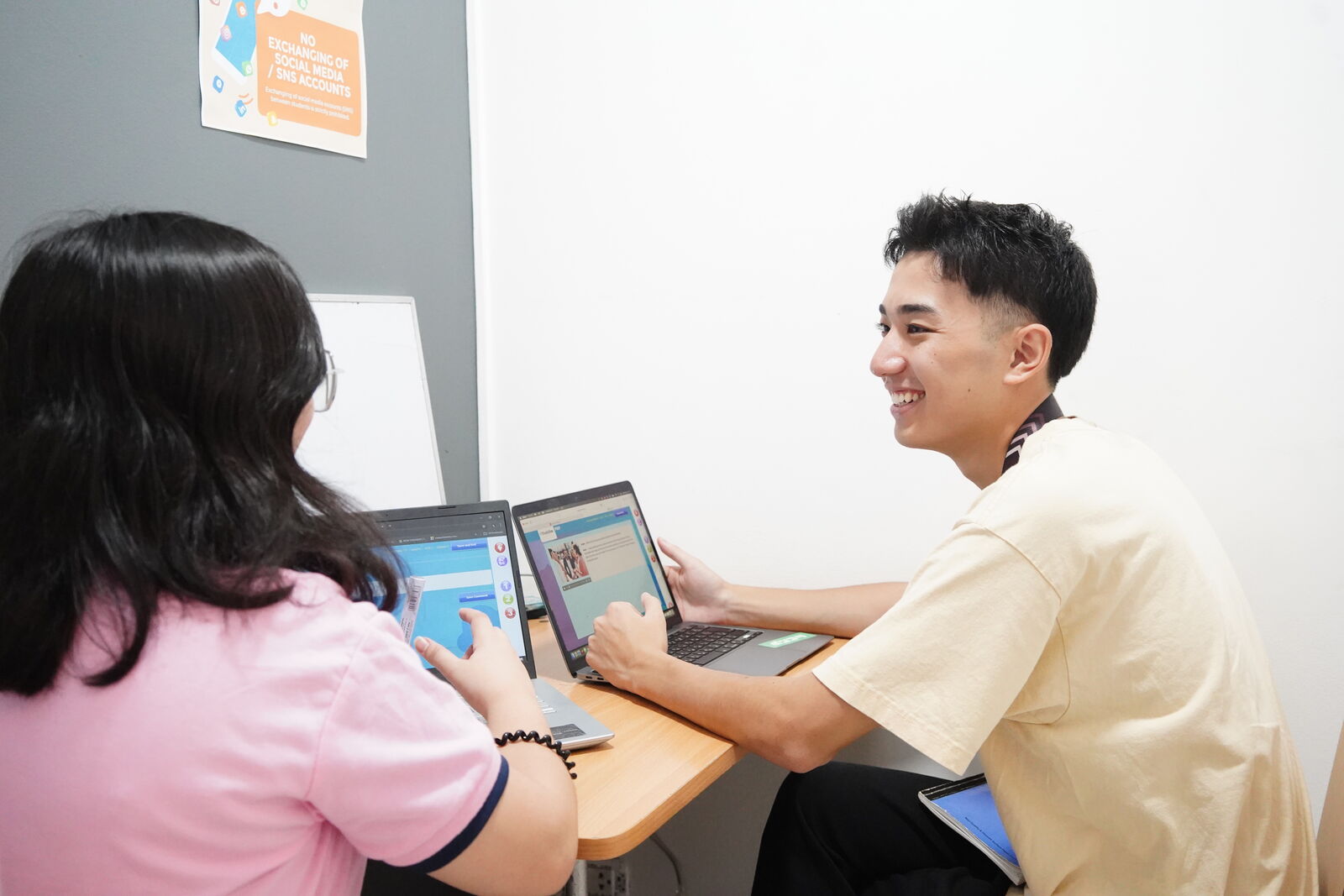
6. And one more thing: studying abroad is far closer to hand than it was
Twenty years or so ago, when I was at upper-secondary school, a fair number of people heard the words "study abroad" and pictured something like:
"living overseas for six months or a year" "a decision that takes real resolve" "a special experience only some people have".
So what do the actual numbers say?
In the Japan Student Services Organization's (JASSO) survey for the 2005 school year, 20,689 Japanese students went abroad to study under inter-university agreements and similar arrangements. Of those, 8,301 were on short programmes of under a month.
Some twenty years on, the figure for the 2024 school year — students studying abroad "under agreements and similar arrangements" — was 57,262. Comparing like with like on that same basis, that is about 2.8 times the 2005 figure.
The short programmes are what I'd particularly like to draw attention to.
Of those 57,262 agreement-based students in the 2024 school year, 34,090 were abroad for under a month. Set against the 8,301 of 2005, that is a full 4.1 times as many.
Note: figures for study abroad not based on agreements have only been compiled since the 2009 school year, so in order to compare twenty years ago and today fairly, both years here are given on the same "under agreements and similar arrangements" basis. There have also been changes to the types of institution surveyed from the 2013 school year onwards.
That strikes me as an enormous shift.
From an era in which "study abroad" meant a year, the option of "a week, a fortnight, a month to begin with" is becoming an ordinary one too.
Indeed, in the same JASSO survey, of the 91,054 students in total that Japanese universities and other institutions recorded as studying abroad in the 2024 school year, 60,301 were away for under a month. Roughly two in every three.
Working adults who can't take long stretches away from their job or their studies. Students going abroad for the first time who want to start with something short. Families who would like to give their child some experience of the wider world.
Rather than leaving it at "one day I'd like to study abroad", you can increasingly choose a length that fits the life you lead.

7. Studying abroad isn't somewhere you go once you can already speak English
Some of you reading this may be thinking:
"But my English isn't good enough to study abroad yet."
Twenty years ago I thought precisely that. Knowing what I know now, here is what I would tell my younger self.
You don't study abroad once you can speak English. You study abroad in order to become able to use it.
There is no need to be fluent from the outset.
It's fine if you can't manage "Could you say that again?" It's fine if all that comes out are single words. It's fine if you don't understand a thing your teacher says for the first few days.
What matters is that instead of
"I don't understand, so I'll say nothing"
you build up the experience of trying to make yourself understood from a position of not understanding.
Once you are studying abroad, English is no longer "a subject you sit exams in".
You greet your teacher in the morning. You put your own views across in class. You talk with friends in the canteen about how your day went. You go out at the weekend and talk to local people.
Every situation of the day becomes practice in using English.
That was the other face of learning English — the one I only noticed when I first went abroad, twenty years ago.

Afterword
When I went to Australia as an upper-secondary student, what I felt most sharply was the frustration of realising I couldn't speak English.
Looking back now, though, I think something else was bigger still: the joy of discovering that English lets you connect with people you'd never met before.
Even with the grammar wrong and the pronunciation short of perfect, the moment you are understood is a genuine delight.
It was that experience that kept my interest in other countries and other cultures alive in the years that followed.
If you are reading this and thinking, "I'm no good at English, but I am a little curious about the world beyond Japan," then I would like to pass on to you exactly what I wanted to say to myself twenty years ago.
It's all right. You don't have to wait until your English is perfect.
Take one step into a world you don't yet know, and English gradually stops being something you study and becomes a language for connecting with people.
I would be delighted if you got to experience a moment like that for yourself.