



Hello, everyone! I'm part of the study-abroad support team.
"My first time abroad." "A country I've never been to." "And on my own, too." When all three come together, I suspect many people feel nervous long before they feel excited.
I'm one of them. Even now, I often wish, only half joking, that I had the nerve of a manga hero: the kind who dives into anything new thinking, "It'll work out! This looks fun!"
In the run-up to departure, the what-ifs start: "What if I get on the wrong plane?" "What will they ask me at immigration?" "Can I really get from the airport to the school on my own?" "What if I can't make friends with anyone?" One after another, you picture things that haven't even happened yet.
But once I was actually abroad, there was one moment I had again and again: "Huh. That was more normal than I'd imagined."
Of course, this is abroad, so plenty of things will be different from Japan. There will be times when you're stuck, and you will make mistakes. But knowing even one answer to "What would I do if something went wrong?" before you leave makes the worry a great deal smaller.
Here, I'll go through ten worries I hear especially often from people about to study abroad alone for the first time, question by question. I'm writing with readers setting off from Japan in mind, so a few details, such as mobile providers and embassies, are the Japanese ones.
First, the short version...
What matters on your first solo study trip abroad is not getting through without a single problem.
You might get lost in an airport you don't know. You might not catch what's said to you in English. There may be days when the food doesn't suit you, and nights when you feel lonely. And that's fine.
What matters is knowing what to do next when you're stuck.
Take the schools we work with, for example. B'Cebu offers airport pickup around the clock; B'Hoian arranges transfers from Da Nang International Airport and sends you details such as the meeting point before you leave; and ILSC Sydney offers a paid airport transfer. In other words, not every study programme abroad leaves you to sort everything out on your own the moment you land.
Let's take the worries in turn.
① Will I get on the wrong plane?
There are fewer things to check than you might think
Essentially, you only need to check five things:
- ① The airline
- ② The flight number
- ③ The destination
- ④ The gate
- ⑤ The boarding time
The flight number matters most. However many flights to "Manila" or "Sydney" are listed at around the same time, you'll be fine as long as you match the flight number on your boarding pass with the one on the departures board. Your boarding pass is checked at the gate, too.
If you have a connection, follow the signs for "Transfer" or "Connecting Flights".
If you get confused, show your boarding pass to a member of airport staff and ask, "Where should I go?" That alone will do.
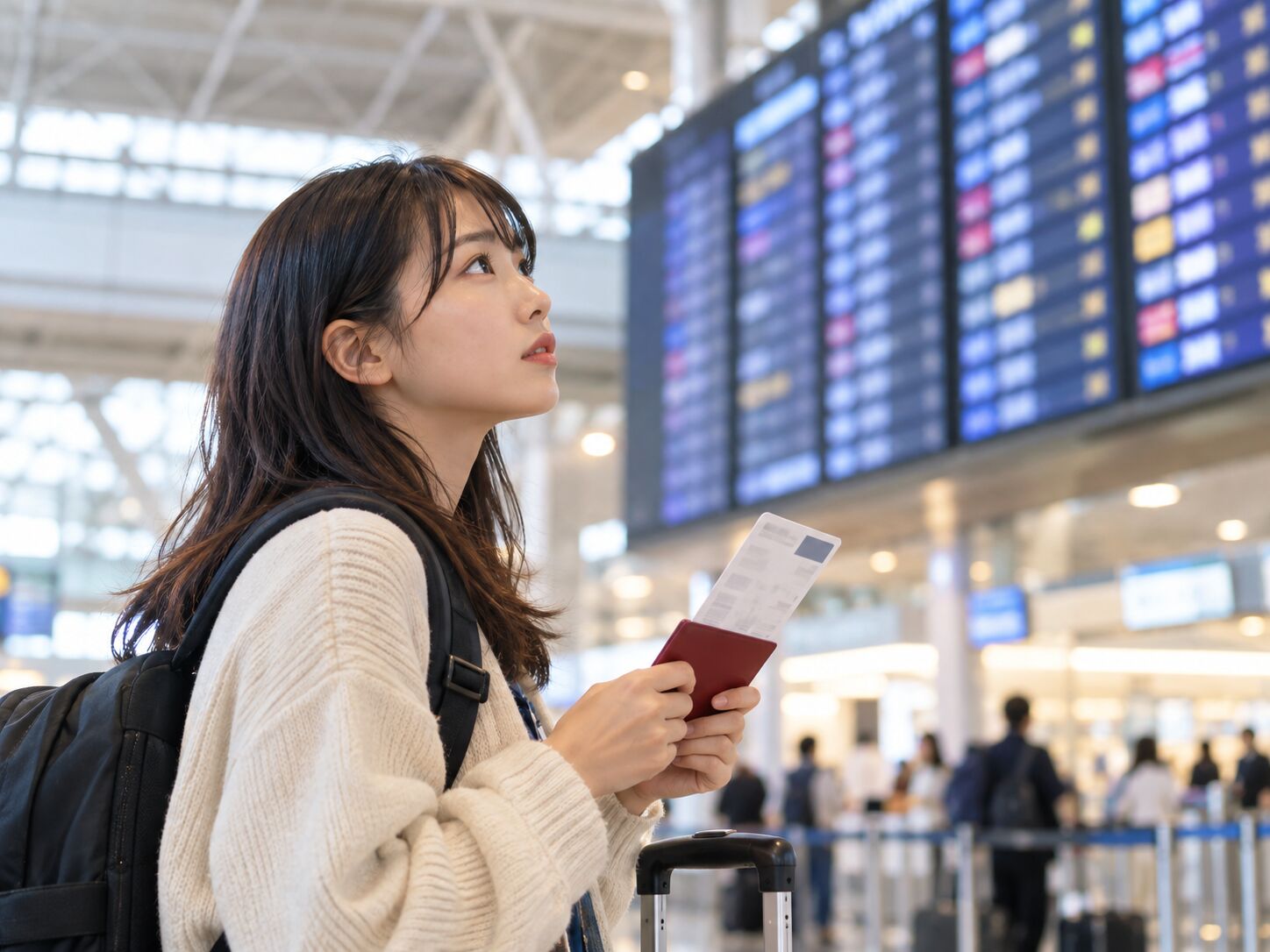
② What if I can't follow the English at immigration?
You don't need to answer in perfect English
Many people find this the most daunting moment of their first trip abroad. I was no different: at my first immigration desk, my heart was pounding at the thought of being asked something difficult.
For a short-term student, though, the questions are mostly about why you're visiting, how long you're staying and where.
If they ask "Why are you here?", "To study English" is fine. For "How long will you stay?", "Two weeks" will do. That's about the level to expect. And if you didn't catch the question, "Sorry, could you say that again?" is perfectly acceptable.
In Australia, the major international airports have SmartGates: eligible travellers scan their passport, answer the questions on screen and pass a facial-recognition check. If the gate can't process you, you're sent to an officer instead.
For the Philippines, you currently need to register with eTravel before you arrive. The Philippine Bureau of Immigration advises registering or updating your details at least 72 hours before you're due to travel, and the official eTravel service is free.
🛂 Want to handle your pre-arrival online applications yourself?
Our Australian ETA Application Guide, Singapore SG Arrival Card Application Guide and Philippines eTravel Application Guide take you through each application step by step, with screenshots, so even a first-timer can complete it without getting lost.
So immigration isn't an English test. Have the necessary documents ready and give simple answers to what you're asked. That is enough.
③ Can I really get from the airport to my school?
For your first study trip abroad, I'd recommend the airport transfer
This is a big one too, isn't it? The moment you step out of the airport, you're in a city you don't know, with transport you don't know, taxis, local currency, and your luggage on top of it all.
You don't have to tackle all of that on day one. You can simply use the school's airport transfer.
B'Cebu, for example, runs airport pickups 24 hours a day. B'Hoian's campus is about 40 minutes from Da Nang International Airport; the school arranges a transfer and, before you leave, sends you details including the meeting point and time.
If you're an experienced traveller, trains, buses or a ride-hailing app are of course fine. But on your first trip abroad, leaving just the first journey to someone else is a perfectly respectable safety precaution.
④ Will I make friends?
I can't promise you will, but there'll be plenty of chances to make them
This is another worry I hear very often. "What if everyone's already made friends?" "My English is poor, so I won't be able to talk to anyone." "What if I end up eating on my own...?" I know the feeling.
But here's something I'd like you to keep in mind: many of the people at a language school are foreigners there, too.
South Korea. Taiwan. Vietnam. Brazil. Colombia. Japan. The people gathered there don't speak English as a first language either; they've only just arrived, and they want to make friends too.
A study of international students at universities in Germany also found that the more often students took part in extracurricular activities offered by their university, the stronger their sense of belonging tended to be.
So rather than simply appearing if you wait, friends come more easily once you've joined in somewhere alongside everyone else, even just once.
As a first goal, I think "say Hello to one person" is plenty; there's no need to aim for "make a best friend". Even just "Where are you from?" is enough to get a conversation going.
If you're wondering how friendships and food actually work out, our Cebu article goes into both in more detail: "Are the Rumours About Studying in Cebu True? What We Found on the Ground".
⑤ Will my phone work abroad?
Yes. In fact, on a study trip these days, your phone is a real help
Abroad, your smartphone becomes very important in daily life. These days, there are three main ways to stay connected:
- ① International roaming with your Japanese mobile provider
- ② A local SIM card
- ③ A travel eSIM
If your phone supports it, you can buy a travel eSIM before you leave and switch over to it when you land. Apple, too, lists roaming with your current provider, a local provider or a travel eSIM as ways to use an iPhone abroad.
If it's your first time, I'd recommend deciding how you'll get online before you go. And make sure you also save the following as screenshots:
- The school's address
- Your accommodation address
- Contact details for your airport transfer
- Contact details for school staff
- Your family's phone numbers
The Australian Government's guidance for international students likewise advises keeping your passport, visa documents, the address where you'll be staying, any prescription medicine and emergency contacts, such as family and your education provider, in your hand luggage.
⑥ What about money? Should I take it all in cash?
It's safer not to rely on cash alone
"I'm going abroad, so I'll change ¥100,000 (about US$630) into local currency and put the lot in my wallet!" I wouldn't really recommend that. If you lose it, that's the end of it.
Then again, a single card on its own is a little worrying too. A card can suddenly stop working because of the card company's security checks, a faulty machine, a network outage or simple loss. JAL Pay, Japan Airlines' payment service, also advises having several means of payment, such as cards and cash, when you travel abroad.
So, if it were me, I'd split things between a credit card, a spare card and a small amount of cash, and I wouldn't keep them all in the same wallet. That part matters as well. Visa, for its part, suggests using local ATMs as you need them rather than carrying a lot of cash.
Money worries become easier to handle if you think not "I mustn't lose anything" but "if I lose one thing, I'll still be all right".

⑦ What if I fall ill abroad?
What matters most isn't avoiding illness, but knowing who to contact if you do fall ill
Not falling ill in the first place is best, of course. But food, climate, jet lag, long journeys, English you're not used to... in the first few days of a study trip, you're more tired than you might realise.
In some regions abroad, infectious diseases that are uncommon in Japan are circulating, so Japan's Ministry of Health, Labour and Welfare recommends checking local infectious-disease information and any vaccinations you need before you travel. The City of Sapporo's 2026 guidance also urges people to read up on infectious diseases, how to prevent them, vaccinations and so on before going abroad.
For a short-term study trip, the key thing is overseas travel insurance. Treatment at a hospital abroad can cost more than you're used to in Japan. It's worth checking, before you leave, whether your insurer offers services such as these:
- Cashless treatment (no need to pay up front)
- Japanese-language support
- Partner hospitals (hospitals your insurer works with)
And remember that you can turn to the school staff first, too. Even on a solo study trip, you don't have to cope with illness on your own.
⑧ What if I can't get on with the food?
You won't be stuck eating nothing but local food the whole time
Going abroad doesn't mean that every meal will be something you've never seen before, something fiery or a huge slab of meat.
Some language schools provide meals, and if you're in a city you can also use supermarkets, convenience stores, shopping centres, Japanese restaurants and cafés.
I'd also suggest picking up a few things on your first day that you can manage even when you're feeling under the weather: water, bananas, bread, yoghurt, instant noodles and the like.
⑨ What if I can't make out a word of the English?
At first, you'll probably catch even less than you expect, I'm afraid
But that's perfectly normal.
You've studied English at home, sat the TOEIC (an English test widely taken in Japan) and know plenty of vocabulary. Even so, the moment you land, there's the airport staff's English, the shop assistants' English, your teacher's English... and you may find yourself thinking, "...They're so fast!" I've been there too.
But if you don't catch something the first time, say "Sorry?" If you need to hear it again, "Could you say that again?" And if you still don't follow, "Could you speak more slowly?" That's all there is to it.
A language school isn't a place for people who can already speak English. It's where you go to learn to speak it.
So it's quite natural to start out unable to follow your teacher's English at all, or to find that the words won't come in class. If anything, learning to say "I don't understand" is your first big piece of practice abroad.
How, then, do you build on that and keep your English improving? We've gathered some pointers in "Don't just sit back: five habits and mindsets of people who make big gains in English, even on a short study-abroad trip".
⑩ What if I get homesick?
Getting homesick doesn't prove your study trip has failed
Before you go, you think, "I'm going all this way, so I must enjoy every single day!" But not every day will be fun. There are tiring days and lonely days. All sorts of days: that's the reality.
Studies of international students, too, have examined homesickness and loneliness as part of the experience of living abroad.
So if you're alone at night and find yourself thinking, "I want to go home...", please don't take that to mean you're not cut out for studying abroad.
What I'd recommend instead is not trying to get rid of the homesickness, but building a life for yourself there, little by little:
- Go to the same café every morning.
- Say hello to your teacher.
- Make just one friend.
- Go to the supermarket.
- Find a snack you like.
- Try a school activity, just once.
As the study mentioned earlier found, international students who take part more often in the extracurricular activities their university offers tend to feel a stronger sense of belonging.
In short, you're making an everyday life for yourself abroad. Before long, a town you didn't know will start to have your usual places.
Before you leave: a peace-of-mind folder for your phone
If you're going abroad for the first time, this is what I'd have you gather into a single folder:
- ① The photo page of your passport
- ② Your flight ticket and boarding pass
- ③ The addresses of your school and accommodation
- ④ The meeting point and contact details for your airport transfer
- ⑤ Your overseas travel insurance policy and its emergency helpline
- ⑥ Contact details for school staff
- ⑦ Contact details for the Japanese embassy or consulate
- ⑧ The number to call if you lose a credit card
- ⑨ Your family's contact details
- ⑩ Any documents or registration screens required for entry
I'd also recommend registering with Tabireg, the travel-registration service that Japan's Ministry of Foreign Affairs runs for Japanese nationals going abroad. The City of Sapporo also points to Tabireg as a way of receiving emergency information from Japan's diplomatic missions abroad and others, should the need arise.
If you lose your passport abroad, the Ministry of Foreign Affairs advises reporting it to the local police and contacting the nearest Japanese embassy or consulate. Procedures such as a reissue require a police certificate showing that you reported the loss, so I'd suggest going to the local police first and then to the embassy or consulate.
Something going wrong doesn't mean it's all over. There is a proper next step to take.
To sum up: go once you know how to cope, not once you stop being scared
We started with a question: "What's actually so scary about studying abroad alone for the first time?"
Planes. Immigration. School. Friends. Your phone. Money. Illness. Food. English. Homesickness. True, these are all things you wouldn't have to think about if you stayed in Japan, so it's only natural to feel anxious. But having worries doesn't necessarily mean you can't go abroad.
Look at the worries one at a time and they fall into groups: things you can prepare for, things you can get help with, things you can ask the school about, and things time will sort out.
What studying abroad takes is not nerves of steel that nothing can rattle. I certainly haven't got them myself.
What it takes is knowing that if you're stuck, there's someone you can ask; if you don't understand, you can ask again; and if you're lost, you can stop for a moment and check.
If you're thinking, "I'd like to try going abroad, but going alone is a bit scary", then perhaps that "bit scary" isn't a reason to give up, but a sign of what to prepare before you leave.
Beyond helping you choose a school, we'd like to get your study trip ready together with you, checking through the airport, immigration, daily life there and your accommodation, right down to the small questions that make you wonder, "Is it all right to ask this?"
References
- B'Cebu「FAQ: Is airport pickup available 24 hours a day?」. Link
- B'Hoian「Guide & Policy」. Link
- ILSC(2026)「Price List: Sydney」. Link
- Australian Border Force「SmartGates: Arrivals overview」. Link
- Bureau of Immigration, Philippines(2026)「ADVISORY: eTravel Registration」. Link
- Philippine eTravel「eTravel」. Link
- Thies, T. & Falk, S.(2023)「International Students in Higher Education: Extracurricular Activities and Social Interactions as Predictors of University Belonging」. Research in Higher Education, 64(8), 1143–1164. Link
- Apple「海外旅行中にiPhoneでeSIMを使う」. Link
- Study Australia「Pre-departure Checklist」. Link
- JAL Pay「海外ご渡航時のご注意」. Link
- Visa「海外旅行時のお金とカードに関するよくある質問」. Link
- 厚生労働省「海外へ渡航される皆様へ」. Link
- 札幌市(2026)「海外渡航する際の感染症予防について」. Link
- Sawir, E., Marginson, S., Deumert, A., Nyland, C. & Ramia, G.(2008)「Loneliness and International Students: An Australian Study」. Journal of Studies in International Education, 12(2), 148–180. Link
- Poyrazli, S. & Lopez, M. D.(2007)「An Exploratory Study of Perceived Discrimination and Homesickness: A Comparison of International Students and American Students」. The Journal of Psychology, 141(3), 263–280. Link
- 外務省「たびレジ」. Link
- 外務省 海外安全ホームページ「パスポートについて」. Link