



Hello, everyone! I'm part of the study-abroad support team here in Japan.
"I'd love to study abroad. But how much is it all going to cost in the end?" Once the idea starts to take shape, it's one of the first things you wonder about, isn't it?
Tuition, student accommodation, homestays, enrolment fees: you can get a reasonable idea of these from a language school's website or a quote from a study-abroad agency.
But what about the rest? How much is a coffee once you're there? Lunch out with friends? A slightly nicer restaurant at the weekend? Getting to school? A SIM for your phone? I suspect a lot of you are thinking, "I've never been, so I have no idea..."
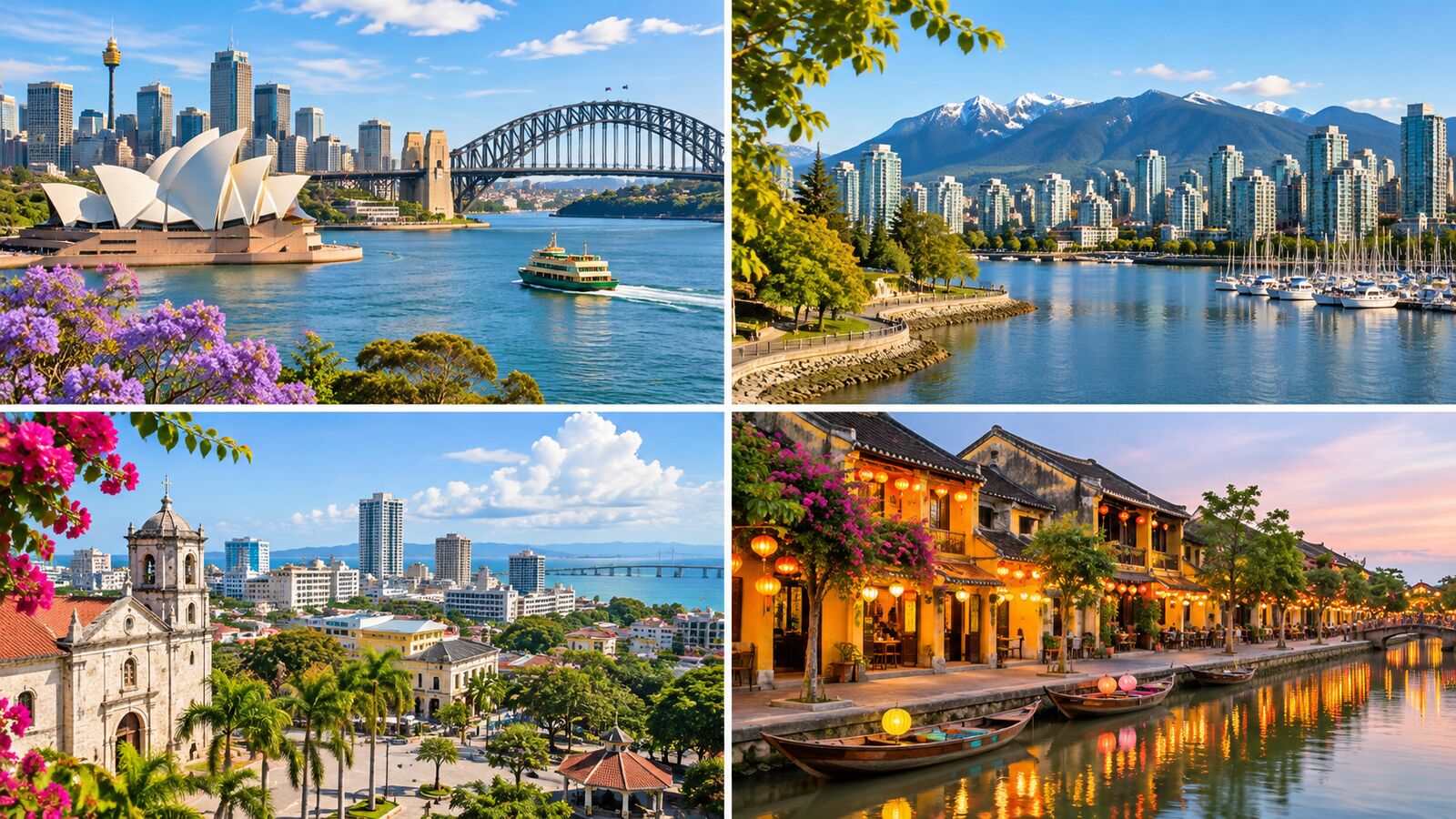
And Sydney, Vancouver, Cebu and Hoi An may all count as "studying abroad", but prices in each are very different.
So this time I've compared the four cities on the everyday costs international students are likely to face, leaving tuition and accommodation aside. The question is simply this: once you're living there, how much money actually leaves your wallet?

First, the exchange rates used here
We're based in Japan, so we did our sums in yen first. But prices given only in four different local currencies would, frankly, leave you asking, "Fine, but what's that in dollars?" So each local price here comes with a rough US-dollar equivalent.
The conversions use the European Central Bank's reference rates for 24 November 2026 (and, for the Vietnamese dong, a market rate from the same day). Rounded, they are:
- A$1 (Australian dollar) = about US$0.66
- C$1 (Canadian dollar) = about US$0.70
- ₱100 (Philippine pesos) = about US$1.57
- ₫100,000 (Vietnamese dong) = about US$3.88
Exchange rates move every day, of course. Treat the dollar figures as a guide to roughly what things cost right now.
The short version: all four cities side by side
First, here are the typical prices we found, converted into one currency so the cities are easy to compare.
| Item | Sydney | Vancouver | Cebu | Hoi An |
|---|---|---|---|---|
| Cup of coffee | about US$3.70 | about US$3.95 | about US$2.45 | about US$1.65 |
| Inexpensive meal out | about US$16.60 | about US$17.45 | about US$4.05 | about US$2.35 |
| Mid-range dinner | about US$43 | about US$35 | about US$11.40 | about US$9.70 |
| Typical SIM | from about US$10 (7 days) | from about US$17.50 (30 days) | around US$4.70 (30 days) | around US$5.80 (30 days) |
| Transport | weekly cap about US$33 | from about US$2 a trip | about US$0.25 a trip | almost no city bus network |
In local currency, a cappuccino in Sydney costs A$5.60 and a meal at an inexpensive restaurant A$25. In Vancouver, the figures are C$5.66 and C$25. In Cebu, expect about ₱155 for a cappuccino and ₱259.50 for an inexpensive meal; in Hoi An, about ₫43,000 and ₫60,000.
Set out like this, the gulf between Sydney and Vancouver on the one hand and Cebu and Hoi An on the other is plain to see.
① Coffee: the more often you drink it, the bigger the gap
One cost that creeps up on you as a student abroad is what you spend in cafés.
After class you think, "I'll just grab a coffee on the way home." A friend asks, "Fancy a café after the lesson?" It happens a lot.
Here's how the average cappuccino compares:
- Sydney: A$5.60 (about US$3.70)
- Vancouver: C$5.66 (about US$3.95)
- Cebu: ₱155 (about US$2.45)
- Hoi An: ₫43,000 (about US$1.65)
One cup a day for four weeks comes to about C$158 (about US$111) in Vancouver, and about ₫1.2 million (about US$47) in Hoi An.
It's "only coffee", but on a longer stay these small costs add up.
That said, I'm certainly not telling you to stay away from cafés abroad. Quite the opposite: cafés are also where conversations start, with your teachers, with friends from other countries and with your host family. I'd simply set aside a "café budget" from the start.
② Lunch: where the gap may feel biggest
Next, an ordinary meal out. Nothing fancy. As a stand-in for lunch, we've used Numbeo's average price for a meal at an "Inexpensive Restaurant".
In Sydney it's A$25 (about US$16.60), and in Vancouver C$25 (about US$17.45). In Cebu, on the other hand, it's ₱259.50 (about US$4.05), and in Hoi An ₫60,000 (about US$2.35).
Quite a contrast.
Eat lunch out on all five weekdays, for example, and it comes to about A$125 (about US$83) in Sydney, C$125 (about US$87) in Vancouver, about ₱1,300 (about US$20) in Cebu and ₫300,000 (about US$12) in Hoi An.
So the very same weekday lunches can add up to a difference of more than US$60 a week, depending on the city.
In Sydney and Vancouver in particular, the key to keeping your living costs down will probably be making good use of:
- supermarkets
- food courts
- lunches aimed at students
- meals at your homestay
③ Dinner: in Sydney and Vancouver, think of eating out as a treat
Next, dinner at a proper restaurant. Here we've taken Numbeo's price for a three-course meal for two at a mid-range restaurant, without drinks, and halved it. Per person, that comes to:
- Sydney: about A$65 (about US$43)
- Vancouver: C$50 (about US$35)
- Cebu: ₱730 (about US$11.40)
- Hoi An: ₫250,000 (about US$9.70)
In Sydney or Vancouver, a slightly nicer dinner with friends can leave you looking at the bill and thinking, "Hang on, that's more than US$30 each..." In Vancouver, tax and tips can push what you actually pay higher still.
In Cebu or Hoi An, by contrast, it's easy to find somewhere a little more upmarket where you can eat well for around US$12 a head. For anyone on a short study-abroad programme who wants to make the most of everyday life there, that makes a real difference.

④ Transport: in Sydney and Vancouver, it helps to know how the system works
Sydney
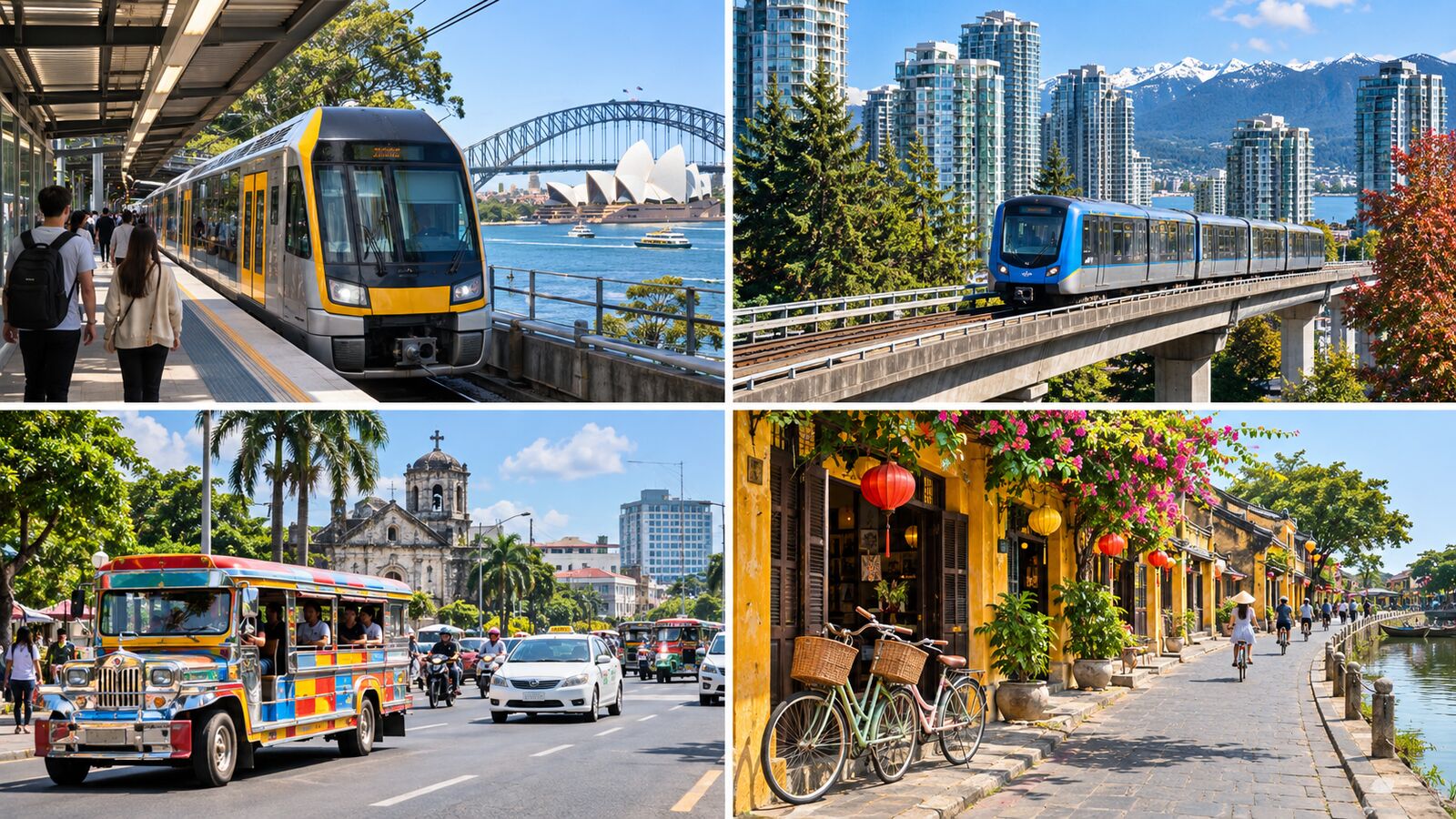
Sydney's public transport runs on the Opal system. Adult fares are capped at A$50 a week (about US$33), and the cap covers:
- trains
- buses
- the Metro
- ferries
- light rail
The Sydney Airport station access fee, however, sits outside it.
So in Sydney, rather than worrying about what your fares might come to, you can see roughly the most you'll pay in a week.
Vancouver
Vancouver uses fare zones. If you pay with Stored Value on a Compass Card, one zone costs C$2.85 (about US$2), two zones C$4.20 and three zones C$5.40. A single fare lets you travel for 90 minutes.
On buses, you generally pay the one-zone fare however far you ride. Depending on where your school and your accommodation are, your transport costs can vary a great deal.
Cebu
In Cebu, one data source puts a trip on local public transport at about ₱15 (about US$0.25). Minimum jeepney fares are ₱14 on traditional jeepneys and ₱17 on modern ones (from 28 September 2026).
Taxis start at about ₱65 (a provisional fare in force since September 2026). Of course, if you use ride-hailing apps such as Grab a lot, your transport costs will go up a little.
Hoi An
Unlike a big city, Hoi An has almost no local bus network. The bus to and from Da Nang costs about ₫20,000 (about US$0.80) a trip. The major taxi companies charge about ₫11,000 to start and around ₫15,000 per kilometre.
A set-up like B'Hoian, which we offer, makes it easy to keep daily life close to the school, so you may be able to cut your everyday transport costs considerably. We describe what life at B'Hoian is like in Are Japanese Trips Too Short? What Comparing Ourselves with Overseas Visitors Reveals About Travelling as if You Lived There.
⑤ SIMs: the two Asian cities are surprisingly cheap
When you're living abroad, you rely heavily on your smartphone for things like:
- Google Maps
- LINE (the messaging app most people in Japan use)
- translation
- keeping in touch with school staff
- Grab
So let's compare SIMs too.
Sydney
Telstra offers a 7-day prepaid plan with 4GB for A$15 (about US$10). There is also a 28-day plan at A$44 (about US$29). If you're only going for a short stay, a one-week plan keeps things simple.
Vancouver
Koodo's 30-day prepaid plan costs C$25 (about US$17.50) and comes with 4GB, or 5GB with Automatic Top-Up.
Cebu
Smart and other networks offer prepaid data plans of around ₱300 for 30 days, which is around US$4.70. There are even cheaper options if you go for a 7-day plan.
Hoi An
Viettel's eSIMs for travellers reportedly come with plans such as 30 days with 5GB a day for around ₫150,000 (around US$5.80). The plans are data-only, and the SIM or eSIM itself may cost extra.
On this front, Cebu and Hoi An stand out for how cheap they are.
⑥ So how much spending money should you allow for a week?
Now let's turn this into an actual study-abroad budget.
To make the cities easy to compare, we've modelled a week for a student who also enjoys eating out now and then:
- 5 coffees
- 5 lunches out at an inexpensive restaurant
- 2 dinners at a mid-range restaurant
- about 10 trips on public transport
- a SIM
Tuition, accommodation, flights, sightseeing, alcohol and shopping are not included.
That gives these rough figures:
| City | Rough weekly cost |
|---|---|
| Sydney | about A$350 (about US$230) |
| Vancouver | about C$305 (about US$215) |
| Cebu | about ₱4,000 (about US$62) |
| Hoi An | about ₫1.2 million (about US$47) |
Note: to err on the safe side for transport in Sydney, we've used the Opal weekly cap of A$50. If you don't use public transport much, your costs will be lower. For Vancouver and Cebu we've assumed about 10 trips a week; Hoi An has almost no city bus network, so there we've assumed one return bus trip to Da Nang. The SIM is assumed to be bought once in the first week (a 7-day plan in Sydney and a 30-day plan in the other three cities).
Sydney, the most expensive, comes to about five times as much as Hoi An, the cheapest. Quite something, isn't it?
⑦ Over four weeks, the gap grows even bigger
Keep up the same kind of life for four weeks, and very roughly you're looking at:
- Sydney: about A$1,380 (about US$915)
- Vancouver: about C$1,150 (about US$805)
- Cebu: about ₱15,000 (about US$235)
- Hoi An: about ₫4.4 million (about US$170)
For the SIM, we've counted one 28-day plan in Sydney and one 30-day plan in each of the other three cities.
Of course, it all changes a great deal depending on whether you:
- eat out every day
- cook for yourself
- are on a homestay with breakfast and dinner included
- are at a language school that provides three meals a day
- take lots of weekend trips
So don't read these figures as amounts you'll definitely need. They're a model for comparing the cities, to give you a feel for prices in each. Even so, I think they're a useful starting point when you're working out the cost of studying abroad.
⑧ In Cebu, you'll spend even less if your school provides meals
What matters here is what the school's fees include.
Language schools in the Philippines, for example, often bundle lessons, student accommodation and even meals together. In that case, you may not even need those five lunches out.
Have your meals at school and eat out with friends only once or twice a week, and you can get by on much less money while you're there.
So when you look at the cost of studying abroad, don't just check whether the school fees are cheap: check how many meals are included, too. That detail counts for a lot. For more on accommodation and meals at our partner schools in Cebu, see Cebu Study Abroad.
⑨ In Sydney and Vancouver, supermarkets make all the difference
If you looked at the Sydney and Vancouver figures and thought, "Ouch!", so did I.
But nobody needs to spend around US$17 on lunch every day and around US$40 on dinner every night.
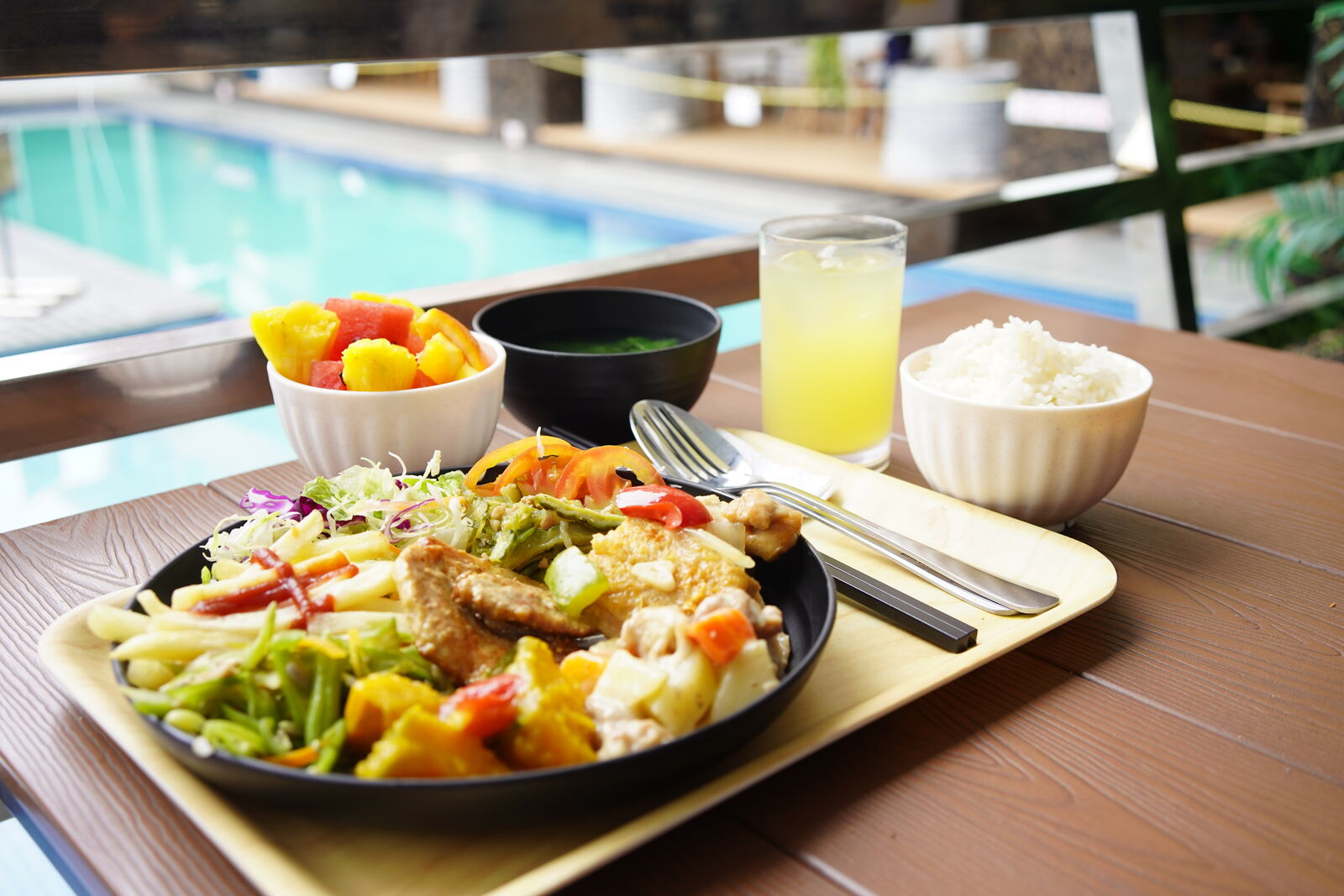
People who live there go to the supermarket, naturally. You can buy bread, salad, yoghurt and fruit and take a packed lunch. Or you can use the shared kitchen at school.
In other words, living on tourist prices or living on local prices makes a big difference here too.
Studying abroad lasts longer than a holiday, which is exactly why trying to live like a local doubles as a way to save money.
⑩ So which city is the cheapest?
Among these four cities, and purely on living costs, Hoi An is the easiest place to keep spending down, followed by Cebu, with Sydney and Vancouver far more expensive.
But I wouldn't recommend choosing where to study on that basis alone. Each city offers something of its own:
- Sydney: the experience of living in an English-speaking country.
- Vancouver: everyday life in multicultural North America.
- Cebu: one-to-one lessons and low living costs.
- Hoi An: daily life, English, travel and wellness, all in one place.
These are differences you can't put a price on.
What matters, I think, isn't finding the cheapest country but deciding what you want to experience within your budget. For more ways to keep the overall cost of studying abroad down, see Six Ways to Book Cheaper Flights and Cut the Cost of Studying Abroad.
Closing thoughts
Putting this four-city comparison together reminded me just how much prices abroad really do vary from country to country.
Hear that lunch in Sydney or Vancouver costs around US$17 and dinner around US$40, and you think, "Eating out every day? No chance!"
But in that case, you can always pick up some bread at the supermarket, or ask where students go to eat.
In Cebu and Hoi An, meanwhile, eating out costs less than it does in Japan. So make the most of meals out with friends. I don't see anything wrong with that.
Studying abroad isn't only about learning English. Finding out how people in another country spend their money and live their lives is a valuable part of the experience of living abroad, too.
Back in Japan, a student picking up a ¥150 (about US$0.95) rice ball at a convenience store might think, "I know prices have gone up, but this is still a bargain." Or, the other way round, "What I'd give for a coffee in Cebu right now."
I hope you'll enjoy everything about living abroad, right down to the differences in what things cost.
Note: prices are as of 25 November 2026 and exchange rates as of 24 November 2026, and both are a rough guide only. Prices vary by shop, plan and how you use them.
References
- Numbeo. "Cost of Living in Sydney". Link.
- Numbeo. "Cost of Living in Vancouver". Link.
- Numbeo. "Cost of Living in Cebu". Link.
- Numbeo. "Cost of Living in Hoi An". Link.
- European Central Bank. "Euro foreign exchange reference rates". Link.
- Transport for NSW. "Adult Opal fares". Link.
- TransLink. "Pricing and Fare Zones". Link.
- SunStar (2026). "Cebu Commuters Decry PUV Fare Hikes Ahead of Wage Increase". Link.
- VinWonders (2025). "Xe bus Hội An Đà Nẵng: Kinh nghiệm di chuyển hữu ích, mới nhất 2026". Link.
- VinWonders (2025). "[Lưu ngay] 8 hãng taxi Hội An uy tín nhất và kinh nghiệm di chuyển". Link.
- Telstra (2026). "Telstra Pre-Paid Mobile Information (From 5 May 2026)". Link.
- Koodo. "Prepaid Phone Plans". Link.
- ViettelData.vn (2026). "Buy Viettel eSIM for Tourists in Vietnam: Best 5G Plans, Prices & Airport Guide 2026". Link.